
Most businesses don’t have a brand problem. They have a clarity problem.
You know what you sell. You know what it costs. You might even know who buys it. But ask yourself this: if your business disappeared tomorrow, would anyone actually notice? Not your employees. Not your vendors. Your customers. The people whose attention you’re competing for every single day. Would they feel the absence?
Most wouldn’t. Not because the product wasn’t good enough. Because the brand was forgettable.
That’s the uncomfortable truth behind most failed launches, stalled growth, and “why isn’t anyone buying” conversations. It’s not a product issue. It’s not a pricing issue. It’s a brand identity issue, and it starts long before anyone opens a design file.
Brand identity is not a logo. It’s not a color palette or a clever tagline. It’s the full, coherent system of who you are, what you stand for, and why that should matter to anyone. It’s the reason 59% of global shoppers will choose a familiar brand over an unknown one, even when the unknown one might be better (Capital One Shopping Research, 2025). Familiarity isn’t luck. It’s built.
What Brand Identity Actually Is & Is Not.
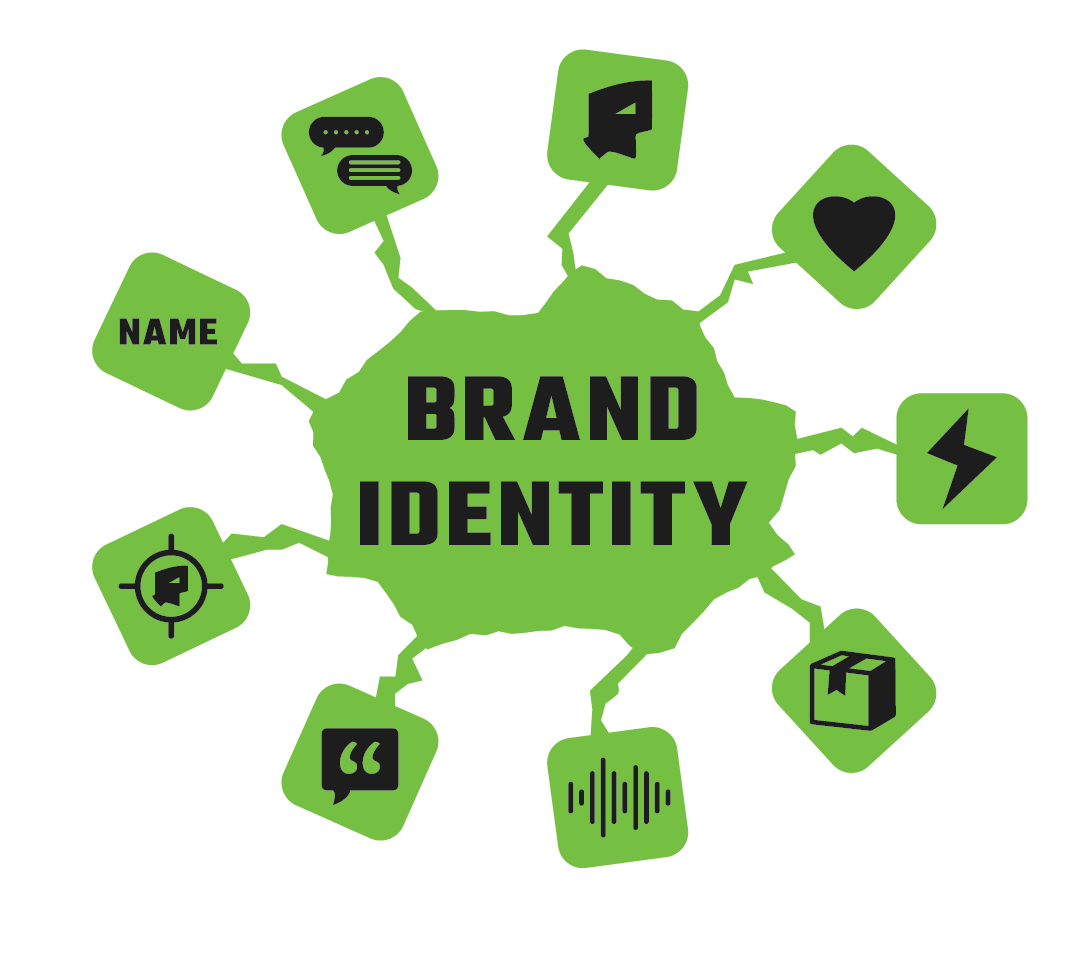
Here’s where most conversations go wrong. People conflate brand, branding, and brand identity as if they’re interchangeable. They’re not.
Your brand is perception. It’s the gut feeling someone has when they hear your name, see your logo, or interact with your team. You don’t fully control it, but you heavily influence it.
Branding is the deliberate, ongoing effort to shape that perception. The campaigns, the content, the customer experience, the choices you make every day about what to say and how to say it.
Brand identity is the system behind all of it. The logos, colors, typefaces, voice, messaging, and visual language that express who you are with consistency, whether someone encounters you on Instagram, at a trade show, or on a coffee cup. It’s the full experience your audience has whenever they interact with your business, at every touchpoint, in every medium (i4s.au, 2025).
Get this system right and it compounds. Brands that present themselves consistently across platforms are three to four times more likely to achieve strong visibility (Energy and Matter, 2024). Get it wrong, or skip it entirely, and even a genuinely great product can feel amateurish. Worse, it can feel like it’s hiding something.
The market is crowded. Attention is scarce. Trust is the currency. Brand identity is how you earn it before you’ve even spoken a word.
Start With Strategy. Not Design.
This is where most founders get it wrong, and where most designers let them down.
Someone registers an LLC, buys a domain, and immediately hires a designer friend to make a logo. Six months later, the logo gets redesigned. Then the colors change. Then the messaging doesn’t match the visuals, and the visuals don’t match the voice, and the whole thing feels like it was assembled by three different people who never met. Because it was.
Brand identity isn’t a design problem. It’s a strategy problem that design solves, but only after the strategy is clear. Every visual decision you make should answer to something deeper. And that something is your brand foundation.
Your Mission, Vision, and Values Are NOT Website Copy
Mission, vision, and values (MVV) are the most under-leveraged tools in brand building. Companies treat them as legal boilerplate, something to slap on the About page and promptly ignore. That’s a mistake.
Your mission is your present-tense purpose. Not who you want to be eventually. Why you exist right now. Your vision is where you’re going, the aspirational destination that makes getting up in the morning mean something. Nike’s vision isn’t “sell more shoes.” It’s “we see a world where everybody is an athlete, united in the joy of movement.” Every campaign they’ve ever made points toward that north star. Your values are the operating principles that guide every decision: how you hire, how you respond to complaints, how you treat vendors when no one’s watching.
Together, they form the backbone of your brand. 89% of shoppers remain loyal to brands that share their values (noissue.co, 2023). That’s not a loyalty program at work. That’s alignment. People can feel the difference between a brand that stands for something and one that stands for whatever sells this quarter.
Before you brief a designer, write these down. Not as corporate-speak. As something a real human would say.
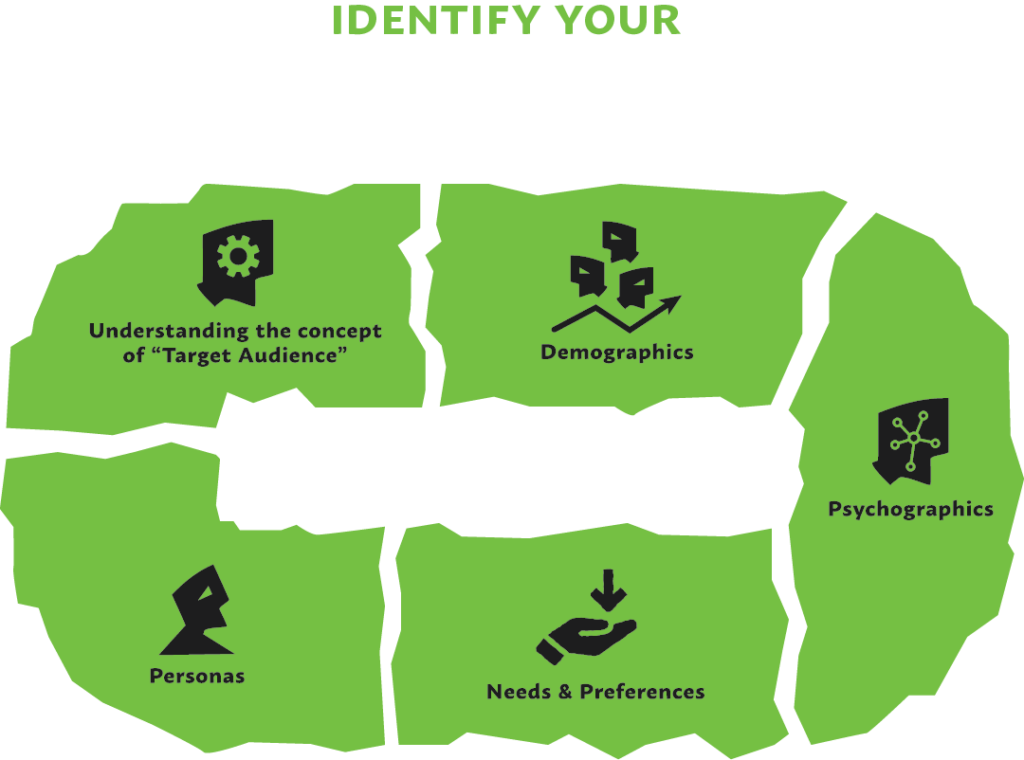
Know Who You're Talking to (Really)
The most common answer to “who is your target audience?” is some variation of “everyone who needs what we offer.” That’s not an audience. That’s avoidance.
The brands that resonate are the ones that speak to someone specific. They know what keeps that person up at night. They know the language that person uses to describe their own problems. They know which Instagram accounts that person follows and which ones they find cringe-worthy.
Build audience personas that go beyond demographics. Age and income bracket are just the start. What does your ideal customer value? What does success look like to them? What brands do they already love, and more importantly, why? What would make them choose you, tell a friend, and come back?
This work shapes everything downstream. The colors you choose, the tone you write in, the platforms you prioritize, the stories you tell. A brand built for nobody specific ends up meaning nothing to nobody. A brand built for someone specific can become something those people evangelize.
Understand Your Competitive Landscape Before You Pick Up a Pencil.
Competition has never been fiercer. Aon’s 2025 Global Risk Management Survey ranked increased competition as the fifth biggest global risk, projected to climb to number three by 2028. The answer isn’t to work harder at being like everyone else. It’s to work smarter at being different.
Study your competitors, but not to copy them. The goal is to find the gaps they’ve left open. How do they position themselves visually and verbally? What do their customers love about them? What do those same customers complain about? Map it out. SWOT analysis isn’t glamorous, but the insight it generates will point directly toward your differentiation opportunity.
The white space in your market is where your brand has room to breathe.
Your Unique Value Proposition is the Whole Game.
At some point, all your strategic thinking has to crystallize into a single answer to a single question: why should someone choose you?
Not why you’re good. Why you’re the right choice for this specific person, in this specific situation, over every other available alternative.
Your Unique Value Proposition (UVP) is that answer, sharpened to a point. It isn’t a tagline. It’s the internal compass that every tagline, headline, and campaign should point toward. Get it vague, and your messaging will be vague. Get it clear, and suddenly every piece of content you create has direction.
46% of consumers will pay a premium for a brand they believe in (Intelemark, 2025). But they can’t believe in something they don’t understand. Clarity isn’t just good communication. It’s a revenue strategy.
Give Your Brand a Personality. Then Give It a Voice.
Brands that resonate don’t just look good. They feel like they could be a person.
Brand personality is the human dimension of your identity, the characteristics that make people feel something when they encounter your brand, not just recognize it. Jennifer Aaker’s seminal research identified five personality dimensions: Sincerity, Excitement, Competence, Sophistication, and Ruggedness. Most enduring brands own one or two of these deeply rather than attempting to be all five.
Apple is Excitement and Sophistication. Patagonia is Ruggedness and Sincerity. Indian Motorcycles is Ruggedness through and through. These aren’t accidental. They’re strategic choices that shape every design decision, every campaign, every hire.
Your brand personality has to match your audience’s world. A mismatch creates a category of distrust that no advertising budget can fully overcome.
Brand identity isn’t a design problem. It’s a strategy problem that design solves, but only after the strategy is clear. Every visual decision you make should answer to something deeper. And that something is your brand foundation.
Voice vs. Tone.
Voice is your brand’s personality in written form. It’s consistent. It doesn’t change based on the channel or the audience or whether it’s a Tuesday.
Tone is how that voice adapts to context. You might be empathetic in a customer service situation and punchy in a social caption. Same brand. Same voice. Different tone.
Edelman’s 2025 Trust Barometer found that 76% of consumers decide whether to trust a brand based on consistent, authentic communication. Inconsistency reads as inauthenticity: corporate language on the website, casual slang on TikTok, robotic copy in email. And inauthenticity kills trust faster than almost anything else.
Document your brand voice. Define it with enough specificity that a freelancer who has never met you could write something that sounds like your brand. That’s the standard. Vague adjectives like “friendly” and “professional” don’t get you there. Examples do.
Design the System.
Not Just the Logo.
Now we get to the part everyone wants to start with.
The logo is important. It’s your brand’s handshake, its signature, the thing people recognize in a quarter-second scroll. Research from DesignRush (2026) shows that consumers form their first impression of a brand in as little as 10 seconds, and it takes five to seven exposures before a logo becomes truly familiar. Those numbers should change how you think about consistency.
But the logo is just one piece of a visual identity system. The brands that win aren’t the ones with the prettiest logos. They’re the ones with the most coherent systems.
What is the Main Job a Logo Has?
Visual elements trigger emotional responses within 50 milliseconds, before conscious thought occurs, according to research published in the Journal of Consumer Psychology (Bethany Works, 2025). That means your logo is communicating before your audience reads a word. The shapes, colors, and typefaces are already doing psychological work.
A great logo is simple enough to be remembered, distinctive enough to be owned, versatile enough to live anywhere, and timeless enough to not need redesigning every three years. Think Nike’s swoosh. Apple’s apple. The FedEx arrow with the hidden forward-pointing shape that you can’t unsee once you’ve seen it.
You don’t need a complicated logo. You need the right logo. Those are very different things.
What Do Brand Colors Do For Your Brand?
Color is not decoration. It’s decision architecture. Research from Gupta et al. (2025), published in the Journal of Marketing & Social Research, found that consumers form initial judgments about a product within 90 seconds of first seeing it, and up to 90% of that assessment is based on color alone. Before someone reads your value proposition, they’ve already had a feeling about your brand. Color caused it.
Adobe’s 2025 survey of 1,000 U.S. consumers found that one in two has chosen one brand over another based on color alone, with Gen Z and millennials leading at 51%. Using a consistent color palette can increase brand recognition by up to 80% (WebFX, 2025).
These aren’t design statistics. They’re business statistics.
Choose your colors intentionally. Blue communicates trust and reliability, which is why it dominates financial services and healthcare. Green signals growth and sustainability. Black commands premium authority. Red creates urgency and energy. The specifics matter less than the intentionality behind the choice and the discipline to stick with it.
Of the world’s top 100 brands, 95% use only one or two colors in their logo (DemandSage, 2026). Simplicity is not a constraint. It’s an advantage.
Why Define Your Brand's Typography?
Fonts have personality. More importantly, fonts have psychology.
Serif typefaces (Times New Roman, Garamond, Playfair Display) signal tradition, authority, and trust. Consumers subconsciously link them with established, credible institutions. Sans-serif typefaces (Helvetica, Futura, Montserrat) read as modern, clean, and approachable. Research shows that appropriate font choices can increase conversion rates by up to 35% (Nova Brand Works, 2026).
Typography is also where brand systems most often break down. A company uses one font on their website, another in email, a third on their slide decks. It creates a visual identity that feels assembled rather than designed. Choose your type system intentionally, document it thoroughly, and use it everywhere.
What is a Visual Style System?
Beyond logo, color, and type, your brand identity includes a visual style language: the aesthetic of your photography, the style of your illustrations, the look of your graphics, the feeling of your layouts.
Are your photos candid or composed? Warm or cool? Do you use photography at all, or illustration? Are your graphics geometric or organic? Open and airy or dense and bold?
Every choice either reinforces your brand personality or dilutes it. Codify these decisions in a Brand Style Guide, the single source of truth for how your brand looks, no matter who’s creating.
Document Everything.
Then Enforce It.
Brand guidelines are the immune system of your identity. They protect the system from the entropy that sets in the moment more than one person is creating content.
Approximately 30% of companies have brand guidelines that are widely used and recognized throughout their organization (Capital One Shopping Research, 2025). The companies in that 30% don’t just have better-looking brands. They have more consistent, more trusted, more profitable brands.
Your brand guidelines should cover: logo usage rules (every variation, every application, every “do not do this”), color system with exact codes, typography hierarchy, photography and imagery standards, tone of voice with real examples, key messages and elevator pitch. Not as a PDF that gets emailed once and never opened again, but as a living document that your team actually uses.
The goal isn’t restriction. It’s freedom within structure: the ability to create boldly and quickly because the decisions are already made.
Consistency Is a Revenue Strategy.
Here’s the part that gets skipped in most brand guides. The implementation.
A brand identity that lives only in a PDF is not a brand identity. It’s a document. The identity only becomes real and valuable when it shows up consistently across every place your audience encounters you.
Presenting a brand consistently across all platforms can increase revenue by up to 23% (Lucidpress, 2019). Meanwhile, 68% of organizations say brand consistency has contributed at least 10% to their revenue growth (Capital One Shopping Research, 2025). These are not soft, intangible outcomes. They are revenue numbers. Treat them accordingly.
Your website is the fullest expression of your brand identity, where your visual system, your voice, your story, and your value proposition all come together. Every social media profile, every email template, every piece of content, every trade show booth, every business card is an opportunity to either reinforce that identity or quietly erode it.
Consistency doesn’t mean repetition. It means coherence. The freedom to show up differently in different contexts while still being unmistakably, recognizably you.
After following a brand on social media, 85% of users feel more connected to that brand (Capital One Shopping Research, 2025). That connection is built through consistency. Every post, every interaction, every touchpoint either deepens it or weakens it. There is no neutral.
Brands Evolve.
Identities Shouldn’t Drift.
No brand identity is permanent. Markets shift. Audiences evolve. The business you are in year five is not the same business you were in year one. Your brand identity needs to grow with it.
Companies typically refresh their visual identity every seven to ten years, with minor updates in between (DemandSage, 2026). The best brand evolutions feel inevitable in retrospect, like the brand was always heading there. The worst feel arbitrary, or worse, like someone got bored.
The difference is intent. Evolve from strategy, not from restlessness. Monitor your brand’s performance: recognition rates, customer perception, consistency across touchpoints, competitive positioning. When something needs to change, change it with purpose.
Coca-Cola has updated its visual identity repeatedly over a century. You always know it’s Coca-Cola. That’s what mastery of brand identity looks like: the confidence to evolve without losing yourself.
The Case for Not Doing This Alone.
Building a brand identity from scratch is genuinely hard work. It requires strategic thinking, design skill, writing ability, market knowledge, and a capacity for the kind of honest self-examination that most founders find uncomfortable.
Many try to do it themselves. Some succeed. Most produce something that looks like it was built by a founder at midnight with a Canva free account and good intentions. The result isn’t just aesthetically weak. It signals something to the market: that the people behind this brand don’t fully believe in it enough to invest in it.
That signal costs you more than the agency retainer would have.
Consider working with a professional brand agency when you’re launching something new and want to do it right. When your current brand no longer reflects who you actually are. When growth has stalled and you sense that brand confusion is part of the reason. When you’re about to be in front of investors, partners, or a new audience that will form a first impression you can’t undo.
The right agency asks hard questions before showing you anything. Strategy comes before sketches. If a branding partner leads with mood boards before they’ve understood your market, your audience, and your competitive position, keep walking.
At Faction Creative, we’ve built our process around four stages: Research & Alignment, Strategic Ideation, Production & Rollout, and Refinement & Growth. In that order. Always. Because a brand built backwards doesn’t stay built.
The Mark That Lasts
Here’s what this comes down to. The market is full of businesses. Products exist in abundance. What is genuinely scarce, the thing that separates companies people love from companies people tolerate, is a brand identity that means something.
The businesses that invest in building that identity intentionally, that do the hard strategic work before the creative work, that document it, apply it consistently, and evolve it thoughtfully, generate 23% more revenue through brand consistency. They build customer loyalty that survives competitive pressure. They attract talent who want to be part of something. They create companies worth more than the sum of their products.
The businesses that skip it stay in the commodity lane. Competing on price. Wondering why their excellent product isn’t enough.
Your brand is not what you make. It is the mark you leave. Build it like it matters, because to the people it’s for, it does.
References
- Adobe Express. (2025). The psychology of color in branding: Top color trends for branding in 2025. Adobe. https://www.adobe.com/express/learn/blog/color-psychology-of-branding
- Aon. (2025). 2025 global risk management survey. Aon plc.
- Bethany Works LLC. (2025, November 30). Psychology-backed logo design: How color & shape influence consumer trust. https://bethanyworks.com/psychology-backed-logo-design-color-shape-consumer-trust/
- Capital One Shopping Research. (2025, November 18). Branding statistics (2025): Awareness, recognition & trends. https://capitaloneshopping.com/research/branding-statistics/
- DemandSage. (2026, January 1). 97 latest branding statistics 2026 (new trends). https://www.demandsage.com/branding-statistics/
- DesignRush. (2026, January 26). Must-know branding statistics for 2026 to boost recognition. https://www.designrush.com/agency/logo-branding/trends/branding-statistics
- Edelman. (2025). 2025 Edelman trust barometer. Edelman Intelligence.
- Energy and Matter Branding. (2024). Brand statistics 2024: Understanding the impact of branding. https://energyandmatterbranding.com/brand-statistics-2024-understanding-the-impact-of-branding
- Gupta, R., et al. (2025). The psychology of brand identity: How colors, fonts, and logos shape consumer behavior. Journal of Marketing & Social Research.
- i4s.au. (2025, December 15). How to build a brand identity from scratch (guide 2025). https://www.i4s.au/how-to-build-a-brand-identity-from-scratch-step-by-step-guide/
- Intelemark. (2025, February 14). How to create a compelling value proposition: A step-by-step guide. https://www.intelemark.com/blog/how-to-create-a-compelling-value-proposition-a-step-by-step-guide/
- Lucidpress. (2019). The state of brand consistency report. Lucidpress.
- noissue. (2023). How to create your brand’s vision, mission and values. https://noissue.co/imprint/how-to-create-your-brands-vision-values/
- Nova Brand Works. (2026, February 28). The psychology of brand identity: How colors, fonts, and logos shape everything. https://www.novabrandworks.com/blog/psychology-of-brand-identity-colors-fonts-logos
- WebFX. (2025). 50+ branding statistics you’ll want to know for 2025. https://www.webfx.com/blog/marketing/branding-statistics/